News
ICO Cyber Incident Reports Hit a Record 1,371 in a Quarter
UK organisations reported 1,371 cyber incidents to the Information Commissioner’s Office between July and September 2026, the highest for any three months on record. This fortnight also brought Microsoft’s explanation for the outage that took Outlook and Teams down for most of a working day, a critical flaw in Java that reaches software many small firms rely on, a House of Lords call for a government-backed cyber insurance safety net, and a warning to anyone with a Synology storage box.
Record cyber incident reports to the ICO, while ransomware reports fall
Figures from the ICO, analysed by Recorded Future News and published on 13 November, show 1,371 cyber incidents reported between July and September, beating the previous quarterly high set in 2023. All data security incidents, including non-cyber ones such as emails sent to the wrong person, also reached a quarterly high of 4,604. Retail and manufacturing reported the most, up from 205 in the second quarter to 296 in the third, and reports from charities and voluntary organisations nearly doubled, from 79 to 145. The ICO opened formal investigations into just 18 of the 1,371.
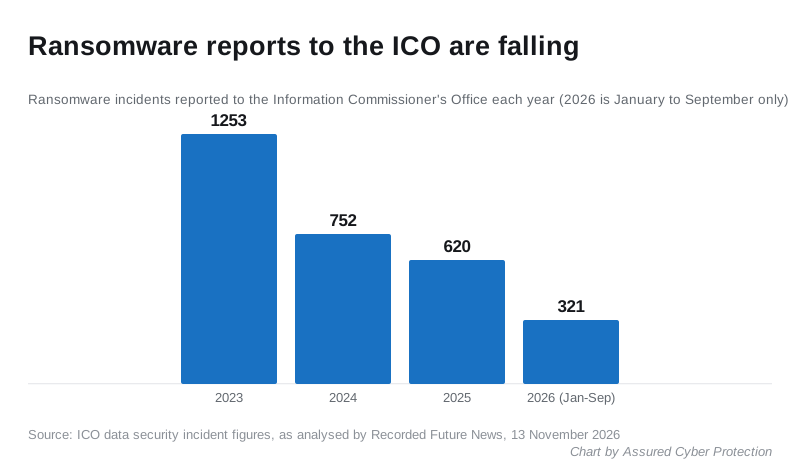
The odd part is ransomware. Reports filed under that heading have fallen every year, from 1,253 in 2023 to 752 in 2024 and 620 in 2025, with 321 in the first nine months of 2026. Most of the new incidents sit in the ICO’s catch-all “other cyber incident” category, and it is not clear whether the ransomware heading counts data theft without encryption. Sophos told Recorded Future News that about 350 British organisations have been named on extortion leak sites so far this year, roughly 50% more than last year.
For a small firm the lesson is that a report to the ICO rarely leads to an investigation, but the 72-hour reporting duty still applies, and getting it wrong is what draws attention; our 72-hour breach deadline calculator works out yours. Our pages on UK GDPR breach types and what cyber insurance covers explain what you have to report and what a policy pays for when you do. Source: Recorded Future News.
Microsoft explains the Outlook and Teams outage
From late on Thursday 12 November, Microsoft 365 users in at least 74 countries could not send or receive email, open some files or see their calendars, and the disruption ran for about 24 hours before Microsoft said service was restored on Saturday. Microsoft said it was not a cyber attack. On Monday 16 November it named three causes: one of its two network gateways for Teams was not working, which overloaded the other; more than 14% of its server capacity was out because of an unrelated problem the day before; and the extra load hit a bug that had sat unnoticed since July. Because the bug was months old, Microsoft could not simply roll back a recent change, and servers that came back were swamped by waiting traffic and fell over again. A final report is promised.
Microsoft extended the time it holds undelivered email to 48 hours while delivery caught up, and delayed messages show the time they arrived rather than when they were sent. If you had invoices, quotes or payment instructions in flight on 12 and 13 November, check they arrived. An outage like this is a business continuity problem rather than a security one: whether a cyber policy pays for lost income from a supplier’s system failure depends on its wording, so read the “system failure” and “dependent business interruption” sections of yours. Our downtime cost calculator puts a figure on a lost day, and our business continuity insurance page covers the cover. Sources: BBC and The Guardian.
Java4Shell: patch Java, and ask about Jira, Confluence and Jenkins
On Tuesday 17 November researchers at Calif published details of CVE-2026-114938, nicknamed Java4Shell, a memory corruption flaw in the Base64 decoder in OpenJDK, the free Java runtime. They rated it 9.2 out of 10 and say an attacker with no password can use it to take over a server. It only affects processors with the AVX-512 feature, not ARM64 machines, and Calif showed unauthenticated attacks on products including Keycloak, Jira, Confluence, Jenkins and PingFederate. Oracle released fixed Java builds the same day as part of a November update covering 652 flaws, and OpenJDK published its own advisory. No attacks had been reported when the details came out, and Calif is holding back product-specific exploit steps to give people time to update.
Most small businesses never install Java themselves, but plenty run software that has it built in, either on their own servers or through a supplier. Ask whoever runs your servers, or your IT provider, which systems use Java and when they will be updated. Our patch deadline calculator works out the 14-day Cyber Essentials deadline for a critical fix like this. Sources: CyberScoop and BBC.
Lords call for a government-backed cyber insurance safety net
The House of Lords national resilience committee published its report, Are we ready? Building a culture of resilience, on 16 November. It wants the Flood Re model, the government-backed scheme that keeps flood cover affordable, kept going beyond its planned 2039 end and adapted to cover risks that are hard to insure, including large-scale cyber attacks. It also says ministers should make sure businesses of all sizes understand how insurance can limit the cost of a breach, and proposes that smaller firms get practical guidance and incentives, including tax reliefs and cheaper insurance, for meeting resilience standards.
Evidence from the Association of British Insurers in the report says its members paid out £197m to help businesses recover from cyber incidents in 2024, up 230% on the year before, and that take-up of cyber cover among smaller firms remains low. The minister, Angela Eagle, told the committee the government still prefers voluntary action to new duties, so nothing changes yet. If you are weighing up cover, our pages on whether you need cyber insurance and what it costs a small business set out the numbers. Source: Insurance Business.
Synology NAS owners: a 2024 flaw is now being exploited
On 18 November the US Cybersecurity and Infrastructure Security Agency added CVE-2024-10441, a flaw in Synology’s DiskStation Manager (DSM) software, to its list of flaws known to be used in attacks. Synology rates it critical (9.8) because it lets a remote attacker run code on the box without logging in. The fix has been out since November 2024: DSM 7.2.2-72806-1, 7.2.1-69057-6, 7.2-64570-4 or 7.1.1-42962-7 and later. Synology NAS boxes are a common place for small offices to keep shared files and backups, so check the DSM version under Control Panel, update if it is older, and make sure the admin page cannot be reached from the internet. A backup on a box an attacker controls is not a backup, which is why insurers ask how yours are kept; see our cyber security checklist. Sources: Synology’s advisory and the CISA catalogue.